The art form
What is taiko? Japan's drums explained
Taiko explained for visitors: what the word means, how old the drums are, the main types, how they are made and how stage drumming took shape.
Book the taiko show ↗Quick answer
Taiko are Japanese drums. In Japan the word means any drum, while elsewhere it usually means wadaiko, the Japanese drums, and kumi-daiko, ensemble drumming on a set of drums. Evidence of taiko in Japan goes back to the 6th century. They have served festivals, rituals, theatre and war, and the modern stage style is far younger, developed from the 1950s.
One word, two meanings
In Japanese, taiko means any kind of drum. Outside Japan, the word usually points to wadaiko, which means Japanese drums, and to kumi-daiko, which means a set of drums played as an ensemble. That second sense is what most visitors picture: players in matching clothes, drums of different sizes and a strong visual rhythm. The drums themselves are made slowly, and preparing the body and the skin can take several years depending on the maker's method.
A very old instrument
Archaeological evidence shows taiko in Japan as early as the 6th century CE. A clay haniwa figure found in Gunma Prefecture, titled Man Beating the Taiko, is considered the oldest evidence of taiko playing. The Nihon Shoki, a classical history of Japan, tells a myth about the goddess Ame-no-Uzume dancing on an upturned sake barrel to coax the sun goddess Amaterasu out of a cave, and historians read her stamping as the mythical start of taiko music.
Drums for war, stage and shrine
Taiko have had many jobs. In feudal Japan they motivated troops, relayed orders and set a marching pace. They accompany noh and kabuki theatre, where they set mood and rhythm. They sound in gagaku, the court music tradition, and in kagura, the Shinto music and dance performed at local festivals. In Buddhist traditions they provide the rhythm for Bon festival dances, played on towers draped in red-and-white cloth with dancers circling below.
The drums you will see
Three families cover most of what you will see on stage. Nagadō-daiko are barrel-shaped and carved or built from staves; their head diameter is traditionally measured in shaku, a unit of roughly 30 centimetres, and runs from 1 to 6 shaku. Shime-daiko are small tunable drums with rope or bolt tension. The ō-daiko is the largest drum in an ensemble, and some are so big they stay in the temple or shrine where they live. Each drum has a job: some carry the beat, others change tempo.
How a drum is made
Historically, large drums were carved from the trunk of a Japanese zelkova tree that had dried for years, and keyaki is still the preferred wood. Skins come mostly from cattle, thicker for larger drums, and are stretched tight over the body by jacks or by rope. Tacks called byō hold the skin in place, and a medium drum needs about 300 on each side. Smaller drums have thinner heads and sometimes a patch of deerskin at the centre, where most strokes land.
Stance, sticks and shouts
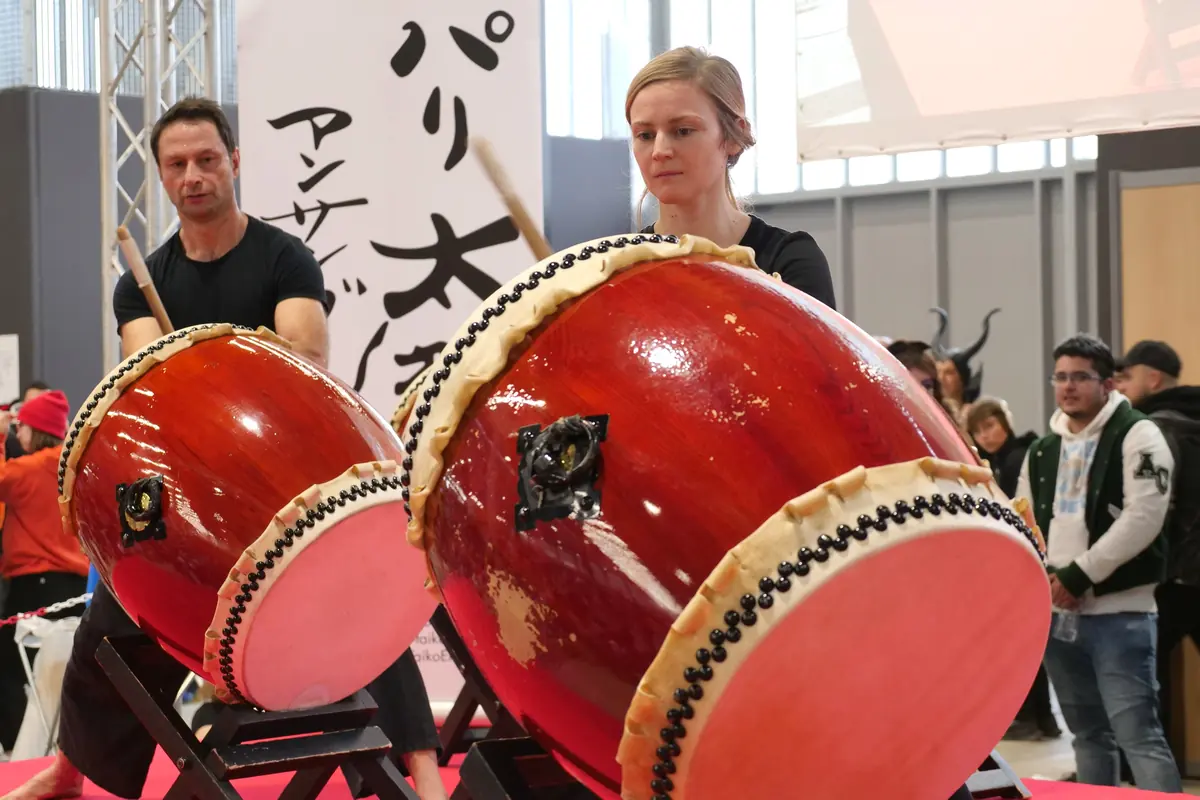
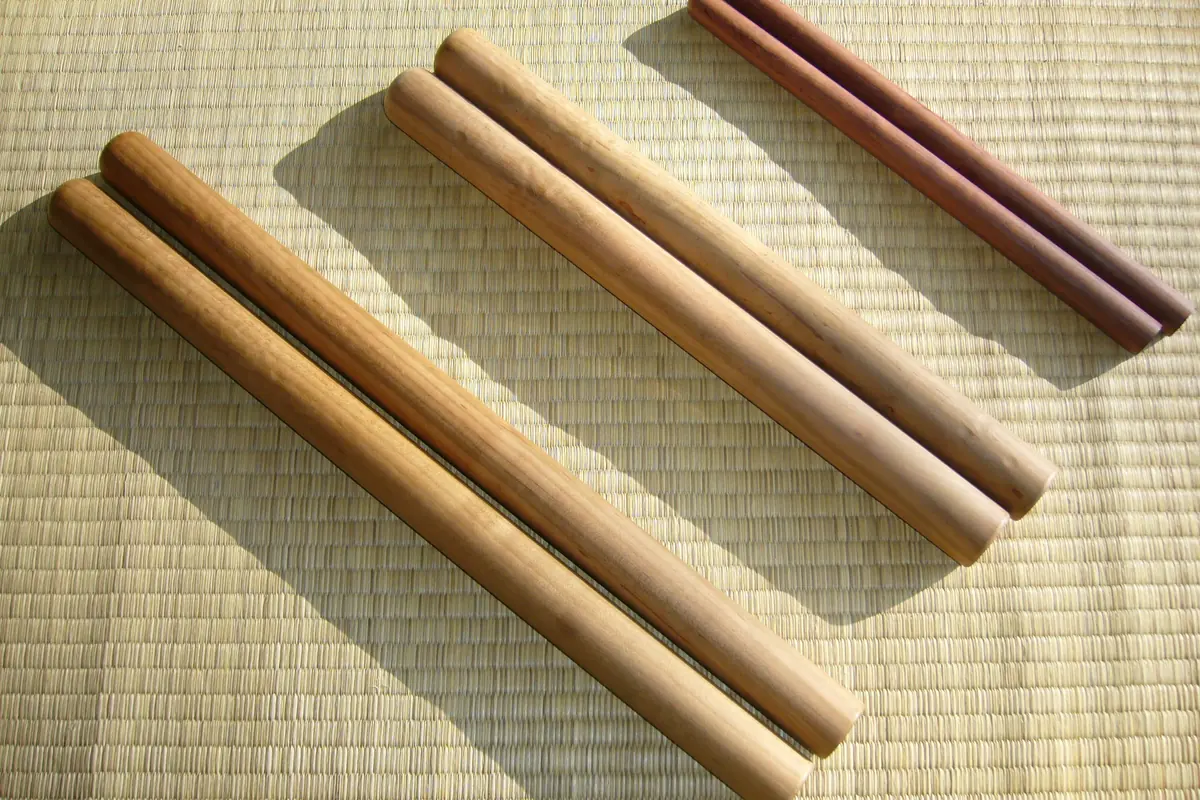
The sticks are called bachi and come in different woods and sizes. Players use a wide, low stance, with the hips facing the drum, and the posture and movement are called kata. Voiced calls, kakegoe and kiai, cue changes in tempo or encourage other players. Silence matters too: the Japanese idea of ma, the space between strokes, shapes a rhythmic phrase as much as the strokes do. Many groups wear happi coats and hachimaki headbands, and many practise before mirrors to refine their form.
From festival to stage
Kumi-daiko was developed by Daihachi Oguchi in 1951, a jazz-trained musician who turned an old piece of taiko music into a score for several players on drums of different sizes. Other groups followed, among them Ondekoza and Kodo. Kodo debuted at a Berlin festival in 1981 and has toured the world since. Today ensembles perform in Japan and in the United States, Australia, Canada, Europe, Taiwan and Brazil, which is why a modern show like UTAGE can build on a stage language already known worldwide.
Frequently asked questions
Is taiko only played in Japan?
No. Kumi-daiko groups are active in the United States, Australia, Canada, Europe, Taiwan and Brazil, as well as across Japan.
What are the sticks called?
Taiko sticks are called bachi. They are made in several sizes and woods, such as white oak, bamboo and Japanese magnolia.
Why do players shout?
The calls, kakegoe and kiai, encourage other players or cue a change in tempo or dynamics during a piece.
Sources